
 98448444



 Jul 16, 2026
Repatriation to Thailand from Singapore | Process & Documents
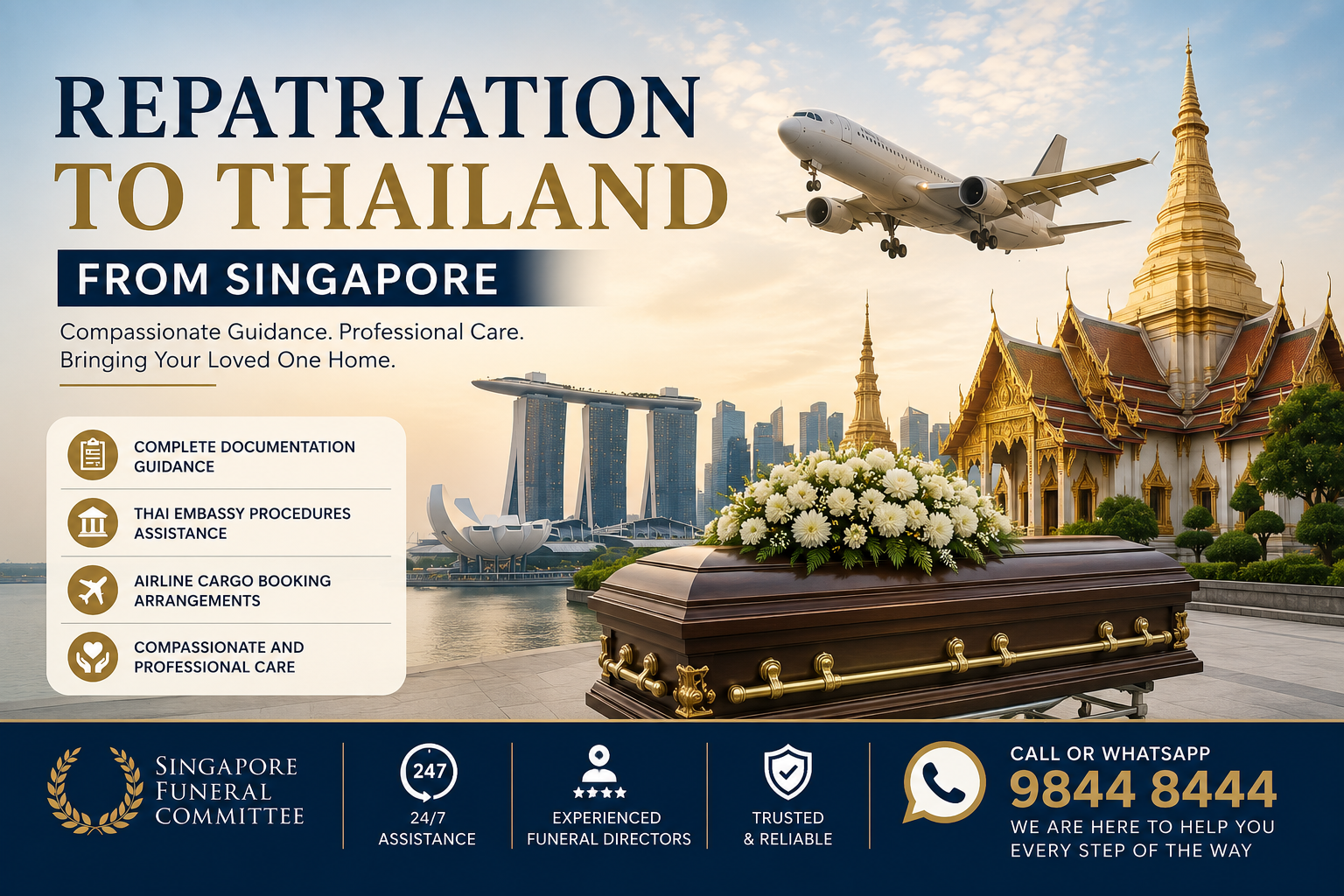
Repatriation to Thailand from Singapore
When a Thai national dies in Singapore, the family may wish to return their loved one to Thailand for funeral rites, cremation or burial.
Repatriation to Thailand from Singapore involves more than arranging an airline ticket. The process may include Singapore death documentation, preparation of the deceased, an NEA coffin export permit, Thai consular documentation, airline cargo arrangements and coordination with the receiving family or funeral provider in Thailand.
Singapore Funeral Committee can assist with the Singapore-side arrangements and coordinate with the relevant overseas parties so that the deceased can be transported respectfully and in accordance with the applicable requirements.
This guide focuses primarily on the repatriation of a Thai national from Singapore to Thailand. Cases involving a deceased person of another nationality being transported to Thailand may have different immigration or import requirements and should be checked individually.
Who May Need Repatriation to Thailand?
Repatriation may be required when a Thai national dies in Singapore while:
- Working in Singapore
- Living with family in Singapore
- Visiting Singapore
- Studying in Singapore
- Receiving medical treatment
- Travelling through Singapore
The family may wish for the funeral ceremony to take place in Bangkok or another province in Thailand.
The intended final destination should be confirmed as early as possible because onward transportation after arrival may need to be arranged separately.
What Happens First When a Thai National Dies in Singapore?
The death must first be medically certified and registered according to Singapore procedures.
If the death is straightforward and the deceased has been released for funeral arrangements, the family may appoint a funeral director to begin the repatriation process.
If the death requires further investigation, the deceased cannot be exported until the relevant Singapore authority permits release of the body.
The family can still discuss the repatriation plan while waiting, but airline transportation should not be treated as confirmed until the body has been released and the required documents can be prepared.
Step 1: Confirm the Identity of the Deceased
The funeral director should obtain accurate information about the deceased before preparing consular and airline documents.
This may include:
- Full name exactly as shown in the passport
- Thai passport number
- Thai identification details where available
- Date of birth
- Date and place of death
- Singapore address where applicable
- Next-of-kin information
- Family contact details in Thailand
- Intended arrival airport
- Final destination in Thailand
Names and identification particulars should be checked carefully. Differences in spelling between documents can cause delays when dealing with consular authorities, the airline or destination-side clearance.
Step 2: Thai Consular and Death-Registration Matters
Thailand’s Department of Consular Affairs provides procedures for Thai citizens who die overseas.
Depending on the circumstances, relatives may need to coordinate with the relevant Royal Thai Embassy or Thai consular authority regarding the death and the documents required for returning the deceased to Thailand.
Thai authorities may also issue or facilitate the applicable Thai death-registration documentation based on the overseas death records.
The exact process should be confirmed for the individual case because requirements may vary according to who is applying, where the relatives are located and the documents already available.
Royal Thai Embassy Coordination in Singapore
Where consular assistance is required, the family or funeral director may need to coordinate with the Royal Thai Embassy in Singapore.
Possible matters may include:
- Notification of the death
- Verification of the deceased’s Thai identity
- Thai death-registration documentation
- Consular guidance for the family
- Documents required for repatriation
The current document requirements should be confirmed directly for the particular case rather than relying on an old checklist.
Step 3: Collection and Care of the Deceased
Once the deceased has been released for funeral arrangements, the funeral director can arrange collection from the appropriate location.
This may include:
- A hospital mortuary
- Another mortuary
- A residence where applicable
- Another authorised location
The deceased can then be prepared according to the repatriation requirements and the family’s wishes.
Is Embalming Required for Repatriation to Thailand?
Embalming should not be described as automatically compulsory for every international repatriation.
Whether embalming is required can depend on:
- Airline requirements
- Thai import or consular requirements
- Transit-country requirements
- The condition of the deceased
- Public-health considerations
- The length and routing of the journey
Where embalming is required, the deceased should be professionally prepared and the appropriate documentation arranged.
Step 4: Religious and Cultural Preparation
Thai families may have different religious or cultural preferences.
Many Thai families are Buddhist and may wish to conduct Buddhist prayers or rites either before departure from Singapore or after the deceased reaches Thailand.
Other families may be Christian, Muslim or follow other traditions.
The funeral director should therefore ask the family about their preferred religious arrangements instead of assuming that one standard programme applies to every Thai funeral.
Religious matters should be coordinated with the family’s chosen monk, temple, priest, pastor or other religious representative.
Buddhist Funeral Arrangements Before Repatriation
Where the family requests Buddhist observances in Singapore, arrangements may include appropriate chanting, prayers or a brief farewell before the coffin is prepared for international transportation.
The exact rites can vary according to the family’s tradition and chosen religious representative.
The funeral programme should also take account of documentation deadlines, coffin preparation and airline cargo acceptance times.
Step 5: Coffin Preparation for International Transportation
The coffin must be prepared in a manner suitable for international air transport.
The exact requirements can depend on the airline and route.
Preparation may include:
- A suitable coffin
- Preparation and preservation of the deceased
- Internal protective arrangements where required
- Sealing arrangements where applicable
- Correct identification of the deceased
- Coffin dimensions and weight for the cargo booking
The funeral director should confirm the transportation requirements before the coffin is finally prepared and sealed.
Step 6: Singapore Coffin Export Permit
A body being exported from Singapore requires the applicable coffin export approval from NEA Port Health.
NEA currently provides an online Application for Coffin Permit Export through its ePortal for funeral directors or authorised persons.
The supporting documents should be prepared before submission so that the export arrangements can proceed efficiently.
What Documents May Be Required in Singapore?
The exact document set depends on the individual case, but repatriation documentation may include:
- Singapore death documentation
- Passport of the deceased
- Thai identification information where applicable
- Medical or preservation documentation
- Embalming certificate where applicable
- Coffin or sealing documentation where required
- NEA Coffin Permit for Export
- Next-of-kin or representative authorisation where applicable
- Thai consular documentation
- Airline cargo documents
- Air Waybill
Additional documents may be requested depending on the airline, authority or circumstances of death.
Step 7: Airline Cargo Booking to Thailand
A deceased person transported internationally is generally handled through specialised airline cargo procedures.
The funeral director or freight representative may need to coordinate:
- Available flight routing
- Departure date
- Transit arrangements where applicable
- Arrival airport
- Cargo acceptance timing
- Coffin dimensions and weight
- Consignee information
- Required documentation
- Air Waybill details
Passenger flight availability does not necessarily mean that the airline has confirmed space for human remains.
The cargo booking should therefore be confirmed separately.
Can the Family Travel on the Same Flight?
Family members may be able to travel on the same general itinerary as the deceased.
However, the coffin is handled through cargo procedures and is not part of the family’s passenger baggage.
Families should avoid buying non-refundable tickets solely on the assumption that the deceased will travel on a particular flight until the cargo arrangement has been sufficiently confirmed.
Which Airport Will the Deceased Arrive At?
The arrival airport depends on the available airline routing and the family’s destination.
For many international repatriations to Thailand, Bangkok may be used as the entry point.
Where the deceased arrives at Suvarnabhumi Airport, Thailand’s Department of Consular Affairs publishes a specific receiving procedure for deceased Thai nationals arriving from overseas.
Receiving the Deceased at Suvarnabhumi Airport
Thailand’s Department of Consular Affairs currently states that documents accompanying the deceased may include:
- The deceased’s passport
- The original or a copy of the Air Waybill
- Death documentation issued through the applicable Thai diplomatic or consular authority
- Other relevant death-related documentation
The receiving relative should also prepare personal identification and the relevant documents supplied by the body-transport or funeral company.
The exact documents should be confirmed before departure from Singapore because requirements may be updated.
What Happens at Suvarnabhumi Cargo?
According to current Thai consular guidance, the receiving party may need to attend the cargo area and present the relevant documents.
The process may involve:
- Document verification at the cargo terminal
- Obtaining the applicable Delivery Order
- Customs procedures
- Security coordination
- Entry of the appropriate funeral transport vehicle into the cargo area
- Release of the deceased for onward transportation
The family should coordinate with the receiving funeral provider or other appropriate local party so that a suitable vehicle is ready when the deceased is released.
Can the Deceased Be Transported Beyond Bangkok?
Yes, subject to appropriate local arrangements.
Many Thai families live outside Bangkok and may need the deceased transported to another province after airport clearance.
The family should provide the final destination as early as possible.
This can help the receiving party estimate:
- Distance from the airport
- Road travel time
- Vehicle requirements
- Local funeral arrangements
- Additional transport charges
- Expected arrival time at the family or funeral venue
Repatriation to Chiang Mai, Phuket or Other Provinces
Not every family intends to hold the funeral in Bangkok.
Depending on flight availability and destination-side arrangements, transportation may involve arrival in Bangkok followed by road transport or another suitable domestic arrangement.
The routing should be reviewed on a case-by-case basis rather than assuming that one airport is suitable for every Thailand repatriation.
Can the Coffin Be Delivered to the Family Home?
This may be possible depending on the local arrangements and the family’s funeral plans in Thailand.
However, direct delivery to a private residence should not be guaranteed before the receiving party confirms the local procedures.
The deceased may instead need to be transferred to:
- A temple
- A funeral facility
- A mortuary
- A church or religious venue
- Another appropriate location
The exact destination should be confirmed with the family and receiving party before departure from Singapore.
Why a Receiving Party in Thailand Is Important
Singapore Funeral Committee can coordinate the Singapore-side arrangements, but a Singapore funeral director does not control the airport release and local funeral procedures in Thailand.
A receiving funeral provider, authorised family member or other appropriate consignee may assist with:
- Airport cargo collection
- Customs clearance
- Document verification
- Funeral transportation
- Transfer to the family’s chosen location
- Coordination of local funeral rites
The receiving party’s details should be confirmed before the airline cargo documentation is finalised.
Who Can Receive the Deceased?
The appropriate receiving person or consignee depends on the airline and destination procedures.
It may be:
- A family member
- A Thai funeral provider
- An authorised representative
- Another recognised receiving party
The receiving arrangement should be checked before the flight departs Singapore.
Thai Funeral Arrangements After Arrival
Once the deceased has been released from the airport, the family can proceed with the intended funeral rites in Thailand.
For a Buddhist family, the deceased may be transported to a temple or another appropriate funeral location for prayers and funeral ceremonies.
The programme may vary according to local custom, the family’s wishes and the selected temple or religious representative.
The Singapore funeral director should be informed beforehand if the receiving temple or funeral provider has any particular coffin or preparation requirements.
Can the Funeral Take Place Immediately After Arrival?
Families should avoid fixing the ceremony solely according to the scheduled aircraft arrival time.
After landing, time may still be required for:
- Aircraft unloading
- Cargo processing
- Document verification
- Customs procedures
- Release of the deceased
- Onward transportation
Flight delays or cargo-handling delays may also affect the actual time that the deceased reaches the funeral venue.
The receiving party in Thailand should therefore advise the family when it is practical to begin the funeral programme.
How Long Does Repatriation from Singapore to Thailand Take?
There is no single guaranteed timeline for every case.
The time required may depend on:
- Release of the deceased in Singapore
- Completion of death documentation
- Thai consular procedures
- Preparation of the deceased
- NEA export approval
- Airline cargo availability
- Transit routing
- Weekend or public-holiday closures
- Receiving arrangements in Thailand
A straightforward case may proceed more quickly than one involving an investigation, complex documentation or limited flight availability.
How Much Does Repatriation to Thailand Cost?
The total cost varies according to the circumstances and services required.
Possible cost components include:
- Collection of the deceased in Singapore
- Preparation of the deceased
- Embalming where required
- Coffin and export preparation
- Singapore permit arrangements
- Consular documentation
- Air freight charges
- Cargo handling
- Thailand airport clearance assistance
- Receiving funeral-provider charges
- Transportation from the airport to the final destination
A quotation should therefore be based on the actual destination and requirements rather than assuming one fixed price applies to all Thailand repatriations.
Why the Final Destination Affects the Cost
A family whose funeral will take place near Bangkok may require less destination-side road transportation than a family whose final destination is several hours away in another province.
When requesting a quotation, families should provide:
- Preferred arrival airport
- Province
- District or city
- Full final destination address where available
- Receiving contact information
This allows the receiving arrangements to be planned more accurately.
Do We Need to Legalise or Translate Documents?
Whether translation, certification, authentication or another form of document verification is required depends on the document and the authority requesting it.
Families should not automatically legalise documents without first confirming the current requirement.
The funeral director and relevant Thai consular authority can identify which documents are required for the particular repatriation.
What if the Deceased Was Not a Thai Citizen?
A non-Thai national may still need to be transported to Thailand if the family intends to conduct the funeral there.
However, the requirements may differ from those applicable to a deceased Thai citizen.
Immigration, import, consular and receiving requirements should therefore be checked specifically before making arrangements.
What Information Should the Family Provide?
To begin planning a Thailand repatriation, the family should provide as much of the following information as possible:
- Full name of the deceased
- Passport number
- Nationality
- Date of birth
- Date and place of death
- Name of the next-of-kin
- Relationship of the next-of-kin
- Thai family contact
- Preferred Thailand arrival airport
- Final destination in Thailand
- Religious requirements
- Receiving funeral-provider details if already appointed
Providing complete and accurate information early helps reduce repeated document corrections later.
Common Causes of Repatriation Delays
International repatriation can be delayed when:
- The deceased has not yet been released
- Names differ across documents
- Required consular documents are incomplete
- Export approval is pending
- The airline does not have suitable cargo availability
- The receiving party has not been confirmed
- The destination funeral time is fixed before clearance arrangements are known
- Public holidays affect government or consular processing
Families can reduce avoidable delays by appointing one authorised contact person and providing the required identification documents promptly.
What Families Should Avoid
Families arranging repatriation from Singapore to Thailand should avoid:
- Booking passenger tickets before coffin cargo space is sufficiently confirmed
- Assuming passenger and cargo reservations are the same
- Using an outdated document checklist without verification
- Fixing the Thailand funeral time immediately after the scheduled aircraft arrival
- Assuming direct home delivery is guaranteed
- Assuming embalming requirements are identical for every case
- Providing inconsistent passport or next-of-kin information
Frequently Asked Questions
Do we need an NEA coffin export permit?
Yes. The applicable Coffin Permit Export must be arranged before a body is exported from Singapore.
Does the Thai Embassy need to be contacted?
Thai consular involvement may be required for death-registration and repatriation documentation. The appropriate procedure should be confirmed for the particular case.
Can a Thai national be repatriated to Bangkok?
Yes, subject to the required Singapore export documentation, airline cargo arrangements and Thailand receiving procedures.
What documents are needed at Suvarnabhumi Airport?
Current Thai consular guidance refers to documents including the deceased’s passport, Air Waybill, applicable death documentation and other related records. The receiving person should also carry identification and the documents provided by the funeral or transport company.
Can the deceased be transported to another province?
Yes, onward transportation may be coordinated after airport clearance, subject to the local receiving arrangements.
Can Buddhist prayers be arranged before departure?
They may be discussed according to the family’s wishes, available time and guidance from the chosen religious representative.
Is embalming compulsory?
It should not be assumed to be compulsory in every case. The applicable requirement depends on airline, destination, transit and public-health considerations.
Can family members fly together with the deceased?
They may travel on the same general itinerary, but the deceased is handled separately through airline cargo procedures.
How soon can the funeral begin after arrival?
The receiving family should allow sufficient time for cargo processing, customs, release and transportation before fixing the final funeral timing.
Can you guarantee the deceased will be delivered directly to the family home?
No absolute guarantee should be made before the destination-side requirements are confirmed. The appropriate final location may be a family residence, temple, funeral facility or another authorised venue.
Body Repatriation Services Singapore
Families who need international funeral transportation can view our Body Repatriation Singapore service page.
Singapore Funeral Committee can assist with collection of the deceased, preparation, Singapore export procedures, consular coordination where applicable and airline cargo arrangements.
Door-to-Door Repatriation from Singapore
If the deceased needs to travel beyond the Thailand arrival airport to another province or family location, see our Door-to-Door Repatriation Singapore guide.
Destination-side transportation depends on local procedures, distance and the receiving arrangements made in Thailand.
24/7 Thailand Repatriation Assistance
If a Thai national has died in Singapore, provide our funeral team with the deceased’s passport details, next-of-kin information, intended Thailand airport and final destination.
We can review the case, explain the Singapore-side requirements and coordinate the practical repatriation arrangements before the flight is confirmed.
For 24/7 repatriation to Thailand from Singapore, call or WhatsApp Singapore Funeral Committee at +65 9844 8444.
 WhatsApp
 98448444