
 98448444



 Jul 23, 2026
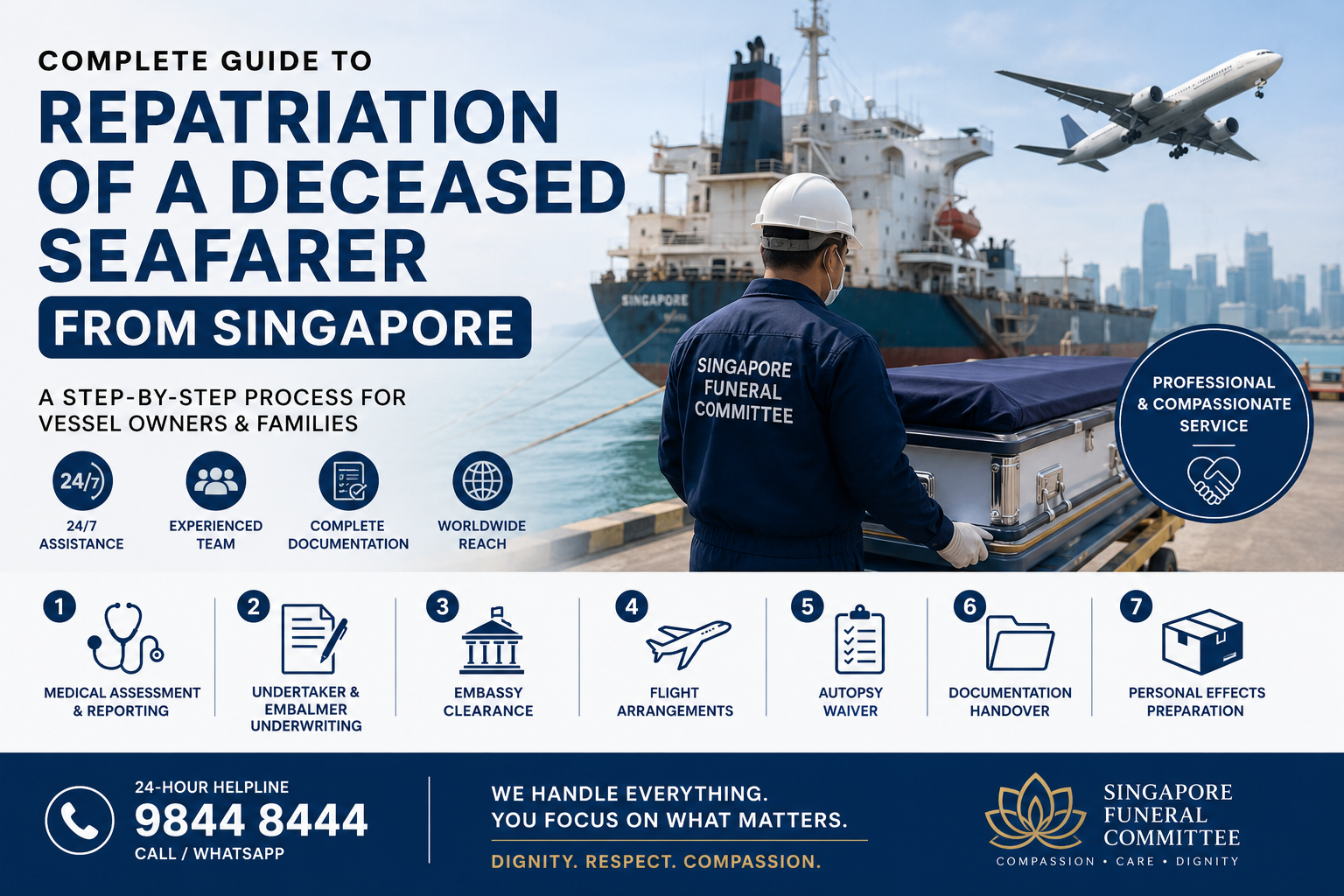
Repatriation of a Deceased Seafarer from Singapore | Process & Documents
Repatriation of a Deceased Seafarer from Singapore
When a seafarer or crew member dies onboard a vessel, at anchorage, in Singapore waters or after being brought ashore in Singapore, the repatriation process may involve more parties than an ordinary overseas funeral transfer.
Deceased seafarer repatriation in Singapore can require coordination between the vessel master, shipowner or manager, shipping agent, employer or manning agency, family, relevant Singapore authorities, embassy or consulate, funeral director, insurer where applicable, airline or cargo agent, and the receiving party overseas.
The exact process depends on where and how the death occurred, the vessel’s flag, the deceased’s nationality, whether an investigation is required, the destination country and the transport arrangements.
Singapore Funeral Committee can assist with the practical funeral and repatriation arrangements after the appropriate authorities have released the deceased for transfer.
Why Seafarer Repatriation Can Be Different
A death involving a vessel may require additional maritime and employer coordination before ordinary funeral arrangements can begin.
Depending on the circumstances, parties involved may include:
- Vessel master or captain
- Shipowner
- Ship manager
- Shipping or port agent
- Employer or manning agency
- P&I insurer or other insurer where applicable
- Relevant maritime authorities
- Police or investigating authorities where required
- Hospital or medical personnel
- Embassy or consulate
- Next-of-kin
- Funeral director
- Airline or cargo agent
- Receiving funeral provider overseas
Not every case involves every party listed above.
Where Did the Seafarer’s Death Occur?
One of the first questions is where the death occurred.
The process may differ if the death occurred:
- Onboard a vessel in Singapore port
- At a Singapore anchorage
- In Singapore territorial waters
- Outside Singapore waters before the vessel arrived
- After the seafarer was brought ashore for medical treatment
- In a Singapore hospital
The location can affect which authority records the death, whether an investigation is required and what documentation is available for repatriation.
Vessel Arriving in Singapore with a Deceased Crew Member
Singapore’s National Environment Agency states that its Port Health Section works with the Maritime and Port Authority of Singapore on inbound health-clearance matters involving vessels with an ill or deceased person onboard.
Accordingly, where a vessel arrives in Singapore carrying a deceased crew member, the ship’s agent and relevant authorities should be informed and the applicable clearance procedures followed before the remains are transferred ashore.
The precise instructions depend on the circumstances of the case and should be confirmed by the responsible vessel representatives.
Step 1: Notify the Appropriate Parties
The vessel operator or shipping agent should ensure that the relevant parties are informed promptly.
This may include:
- Next-of-kin
- Shipowner or ship manager
- Employer or manning agency
- Relevant Singapore authorities
- Embassy or consulate
- Insurer or P&I correspondent where applicable
- Funeral director
- Receiving funeral provider
The funeral director should not begin international transportation until the deceased has been properly released for funeral arrangements.
Step 2: Confirm the Deceased Seafarer’s Identity
Accurate identification is important because the deceased’s particulars will appear across death, export, consular and airline documents.
Information commonly required may include:
- Full legal name
- Passport number
- Nationality
- Date of birth
- Seafarer’s identification where applicable
- Rank or position onboard
- Name of vessel
- Vessel IMO number where relevant
- Employer or manning agency
- Next-of-kin details
- Destination country
- Final receiving address
Names and identification numbers should be checked carefully against the passport before documents are prepared.
Step 3: Medical Certification and Investigation
Before repatriation can proceed, the death must be dealt with according to the applicable medical and legal process.
If a death occurring in Singapore is medically certified online, ICA states that the death is automatically registered and a digital death certificate is issued. :chatgpt-content-reference{index=”1″}
However, not every maritime death follows an ordinary certification route.
Depending on the circumstances, the case may require investigation by the relevant authorities before the deceased can be released.
Examples may include:
- Accidental death
- Unexplained death
- Possible workplace incident
- Death occurring at sea
- Other circumstances requiring official investigation
The funeral director should wait for the appropriate release before arranging export of the remains.
What if the Death Occurred Outside Singapore?
If the seafarer died outside Singapore jurisdiction before the vessel arrived, the applicable death documentation may depend on the place of death, vessel flag, port procedures and authorities involved.
The case should therefore be reviewed individually rather than assuming that a normal Singapore death certificate will always be issued.
The vessel agent, shipowner and relevant authorities should confirm which documents establish the death for the subsequent repatriation.
Step 4: Appoint the Family Representative
A clear next-of-kin or authorised family representative should be identified.
Depending on the case, the funeral director may require:
- Passport or identification of the next-of-kin
- Proof of relationship where required
- Signed authorisation
- Contact information
- Instructions regarding destination and religious arrangements
Where the family is overseas, much of the practical coordination may be carried out remotely, subject to the document and signature requirements of the authorities involved.
Step 5: Transfer of the Deceased Ashore
Where the deceased remains onboard a vessel, transfer ashore should only take place after the applicable maritime, health and other clearances have been obtained.
The shipping agent and funeral director may coordinate the practical transfer once approval has been given.
The arrangements can depend on:
- Vessel location
- Berth or anchorage
- Port access
- Authority instructions
- Availability of suitable transport
- Condition of the deceased
Step 6: Care and Preparation of the Deceased
After release and collection, the deceased can be prepared for international transportation.
Preparation may include:
- Professional care of the deceased
- Embalming where required
- Dressing according to family wishes
- Religious preparation where appropriate
- Placement in a suitable coffin
- Sealing where required
- Identification and documentation checks
Is Embalming Always Required?
No single embalming rule should be assumed for every seafarer repatriation.
The requirement can depend on:
- Destination country
- Airline requirements
- Transit requirements
- Condition of the deceased
- Applicable consular requirements
- Public-health considerations
Where embalming is required, the appropriate certificate can be prepared for the repatriation documentation.
Is a Zinc-Lined Coffin Always Required?
No. It should not be stated that every international seafarer repatriation automatically requires a zinc-lined coffin.
Coffin construction and sealing requirements vary according to the destination country, airline, route and applicable regulations.
The required specification should be confirmed before the coffin is prepared.
Religious Preparation for a Deceased Seafarer
The deceased’s nationality should not be used to assume their religion.
The family may request arrangements according to:
- Christian traditions
- Roman Catholic practices
- Islamic funeral practices
- Hindu traditions
- Buddhist traditions
- Taoist practices
- Sikh traditions
- Another faith
- Non-religious family wishes
Where religious preparation is required, the funeral director can coordinate the practical arrangements with the family’s chosen religious representative.
Step 7: Singapore Coffin Permit Export
A deceased person being exported from Singapore requires the applicable Singapore export approval.
NEA’s ePortal provides an Application for Coffin Permit Export for funeral directors or authorised persons. :chatgpt-content-reference{index=”2″}
The required supporting documentation should be prepared before the application is submitted.
The funeral director can coordinate the Singapore-side application after the deceased has been released and the necessary information is available.
Step 8: Embassy or Consular Documentation
The deceased’s embassy or consulate may need to be involved depending on nationality and destination.
Possible requirements may include:
- Reporting or registering the death
- Verification of nationality
- Review of next-of-kin documents
- Mortuary certificate
- Consular certificate
- No-objection documentation where applicable
- Legalisation or endorsement of documents
- Destination-entry documentation
It is important not to assume that every embassy issues a No Objection Certificate.
Different countries use different document names and procedures.
Step 9: Confirm the Destination Country Requirements
Before the flight is booked, the requirements of the receiving country should be checked.
Possible destination-side requirements may involve:
- Import permit
- Health approval
- Consular documentation
- Coffin specifications
- Airport clearance
- Receiving funeral provider
- Burial or cremation documentation
The final destination should be confirmed early because an international airport may only be the first stage of the journey.
Step 10: Airline Cargo Booking
Human remains transported internationally by air are generally handled through specialised cargo procedures rather than as ordinary passenger baggage.
The cargo arrangement may require:
- Confirmed departure date
- Destination airport
- Transit airport where applicable
- Coffin dimensions
- Coffin weight
- Export permit
- Consular documents
- Receiving-party details
- Air Waybill
Passenger-seat availability does not mean that human-remains cargo space is automatically available.
The cargo booking should be confirmed separately.
Direct Flight or Transit Route?
A direct route may be preferable where suitable cargo service is available, but some destinations require one or more connections.
A transit route can involve additional coordination with:
- Connecting airline
- Transit cargo terminal
- Transit-country authorities where applicable
- Additional documentation requirements
The entire routing should therefore be reviewed before departure.
Step 11: Overseas Consignee and Receiving Funeral Provider
A receiving person or funeral provider should normally be confirmed before international transportation.
Information may include:
- Full consignee name
- Company name where applicable
- Complete address
- Telephone number
- Email address
- Final funeral destination
The receiving party may arrange airport collection, customs or local clearance where required and onward transportation.
Door-to-Door Seafarer Repatriation
For some families, the journey does not end at the destination airport.
The deceased may need to be transported onward to:
- Family home
- Funeral parlour
- Church
- Temple
- Mosque
- Cemetery
- Crematorium
- Another city, province or island
Where possible, the Singapore funeral director can coordinate with the receiving party so the international and domestic portions of the journey connect properly.
Families can also read our Door-to-Door Repatriation Singapore guide.
The Role of the Shipowner and Employer
The responsibilities of the shipowner, employer or manning agency depend on the vessel’s flag, applicable maritime law, the seafarer’s employment agreement, insurance arrangements and other circumstances.
For Singapore-registered commercial ships engaged in international voyages, MPA states that valid financial security must be maintained for certain shipowner liabilities concerning repatriation and compensation for death or long-term disability under the Maritime Labour Convention framework. :chatgpt-content-reference{index=”3″}
For a foreign-flagged vessel, the applicable flag-state rules and employment arrangements should be reviewed separately.
Maritime Labour Convention Considerations
The Maritime Labour Convention provides international standards concerning seafarers’ welfare and shipowner responsibilities.
Among other matters, the MLC provides for financial security relating to repatriation and compensation for death or long-term disability in circumstances covered by the Convention. :chatgpt-content-reference{index=”4″}
The exact legal or financial responsibility in an individual deceased-seafarer case should be determined by the relevant shipowner, employer, insurer, flag state and professional advisers.
A funeral director coordinates the funeral and transportation arrangements but should not be treated as determining employment, insurance or compensation liability.
P&I Club or Insurer Coordination
Some maritime death cases involve a Protection and Indemnity insurer, correspondent or another insurer.
The insurer may be involved in matters such as:
- Approval of funeral or repatriation expenses
- Appointment of local representatives
- Coordination with shipowner or manager
- Documentation
- Family communication
- Transportation arrangements
However, not every case uses the same insurance arrangement.
The shipowner or employer should confirm the appropriate contact.
Personal Belongings of the Deceased Seafarer
A seafarer’s personal belongings may remain onboard after the deceased has been transferred ashore.
The International Labour Organization’s Maritime Labour Convention guidance provides that shipowners or their representatives should take measures to safeguard property left onboard by a deceased seafarer and arrange for its return to the next-of-kin. :chatgpt-content-reference{index=”5″}
The vessel representative should prepare an inventory or handover record where appropriate.
Items can include:
- Passport or identification documents
- Mobile phone
- Wallet
- Clothing
- Personal effects
- Documents
- Luggage
The handling of valuable, controlled or restricted items should be discussed separately with the responsible vessel representative.
What if the Family Is Overseas?
In many seafarer cases, the family is not in Singapore.
Practical funeral arrangements may therefore be coordinated through:
- Telephone
- Employer or manning agency
- Embassy
- Authorised family representative
The funeral director can advise which documents can be provided electronically and which originals may be required.
See our Funeral Services for Overseas Families guide.
Can Family Members View the Deceased in Singapore?
Whether a viewing is possible depends on the circumstances of the death, release of the deceased, condition of the remains, family wishes and timing of the international transportation.
If the family wishes to travel to Singapore, they should inform the funeral director early so that the practical arrangements can be considered.
Can Religious Rites Be Conducted Before Repatriation?
Where appropriate and permitted, families may arrange prayers, blessings or other religious observances before departure.
The arrangements should take account of:
- Family wishes
- Religious tradition
- Release of the deceased
- Available time
- Export schedule
- Airline cargo timing
How Long Does Seafarer Repatriation Take?
There is no single guaranteed number of days.
The timeline may depend on:
- Release of the deceased
- Medical or investigative procedures
- Death documentation
- Next-of-kin authorisation
- Vessel and shipping-agent coordination
- Preparation of the deceased
- NEA export approval
- Embassy or consular requirements
- Destination-country approval
- Airline cargo availability
- Transit routing
- Receiving-party readiness
- Weekends and public holidays
A case involving an investigation may take longer than one in which the deceased has already been released and all documentation is available.
How Much Does Deceased Seafarer Repatriation Cost?
The total cost varies according to the individual case.
Possible components include:
- Transfer of the deceased
- Professional preparation
- Embalming where required
- Coffin preparation
- Export documentation
- Consular procedures
- Port or vessel-related transportation
- Air freight
- Cargo handling
- Destination funeral-provider charges
- Onward transportation
Where an employer, shipowner or insurer is responsible for costs, approval procedures should be clarified before optional services are confirmed.
Information Needed to Review a Seafarer Case
For an initial assessment, provide:
- Full name of deceased
- Nationality
- Passport details
- Name of vessel
- Vessel IMO number where available
- Current vessel location
- Where the death occurred
- Current location of the deceased
- Shipowner or manager
- Shipping agent
- Employer or manning agency
- Next-of-kin details
- Religion where relevant
- Destination country
- Preferred airport
- Complete final destination
Common Causes of Delay
A deceased-seafarer repatriation may be delayed when:
- The deceased has not been released
- An investigation is ongoing
- Identity information is incomplete
- Family authorisation is pending
- The vessel agent has not provided required documents
- Embassy documentation requires correction
- NEA export approval is pending
- Destination-country approval is incomplete
- Airline cargo space is unavailable
- The overseas consignee has not been confirmed
- The final destination is unclear
What Shipowners and Agents Should Avoid
To reduce avoidable delays, vessel representatives should avoid:
- Assuming every country requires the same consular documents
- Assuming every case requires an NOC
- Assuming every coffin must be zinc-lined
- Booking passenger flights before cargo acceptance is confirmed
- Using inconsistent spellings of the deceased’s name
- Providing only the destination country without a final city or address
- Waiting until the last moment to confirm the overseas consignee
- Fixing a funeral time immediately after the aircraft’s scheduled arrival
Frequently Asked Questions
Who normally contacts the funeral director in a seafarer death?
The initial contact may come from the shipowner, ship manager, shipping agent, employer, manning agency, insurer, embassy or family.
Can the deceased be transferred directly from the ship to the airport?
Not automatically. The appropriate medical, authority, port, funeral, export and cargo procedures must first be completed.
Does every deceased seafarer case require police investigation?
No universal rule should be assumed. Whether an investigation is required depends on the circumstances of the death and the relevant authorities.
Is an NEA Coffin Permit Export required?
A body being exported from Singapore requires the applicable Singapore Coffin Permit Export.
Does every embassy require a No Objection Certificate?
No. Consular procedures vary by nationality and destination. Some countries use an NOC, while others issue different certificates or do not use that terminology.
Does the coffin always need to be zinc-lined?
No single coffin specification applies to every destination. The applicable destination and airline requirements should be checked first.
Can the seafarer’s family travel on the same flight?
Family members may be able to use the same general itinerary, but the deceased is handled separately through airline cargo procedures.
Can the deceased be delivered to the family home overseas?
This may be possible through appropriate destination-side arrangements, depending on the country and receiving funeral provider.
Who handles the deceased’s personal belongings?
The vessel owner, operator or representative should coordinate safeguarding and return of property left onboard, while the precise handover process depends on the case.
Can cremation take place in Singapore instead?
In some cases the family may choose cremation in Singapore and transport the ashes overseas, subject to family wishes, religion and the applicable documentation.
International Repatriation from Singapore
For a broader overview of overseas funeral transportation, see our International Repatriation from Singapore guide.
Body Repatriation Services Singapore
For professional assistance, visit our Body Repatriation Singapore service page.
Singapore Funeral Committee can assist with collection and care of the deceased, preparation, Singapore export documentation, consular coordination, airline cargo arrangements and communication with the overseas receiving party.
Repatriation Funeral Package Singapore
Vessel owners, employers and families may also view our Repatriation Funeral Package Singapore for information about international funeral arrangements.
The final quotation will depend on the deceased’s circumstances, destination, transport route, documentation and services required.
24/7 Deceased Seafarer Repatriation Assistance
If a seafarer or crew member has died onboard a vessel or in Singapore, provide our funeral team with the deceased’s passport details, nationality, vessel name, current location, shipping-agent contact, next-of-kin information, intended airport and complete final destination.
We can review the practical Singapore-side funeral and repatriation requirements and coordinate with the relevant parties after the deceased has been released for funeral arrangements.
For 24/7 deceased seafarer repatriation assistance in Singapore, call or WhatsApp Singapore Funeral Committee at +65 9844 8444.
 WhatsApp
 98448444